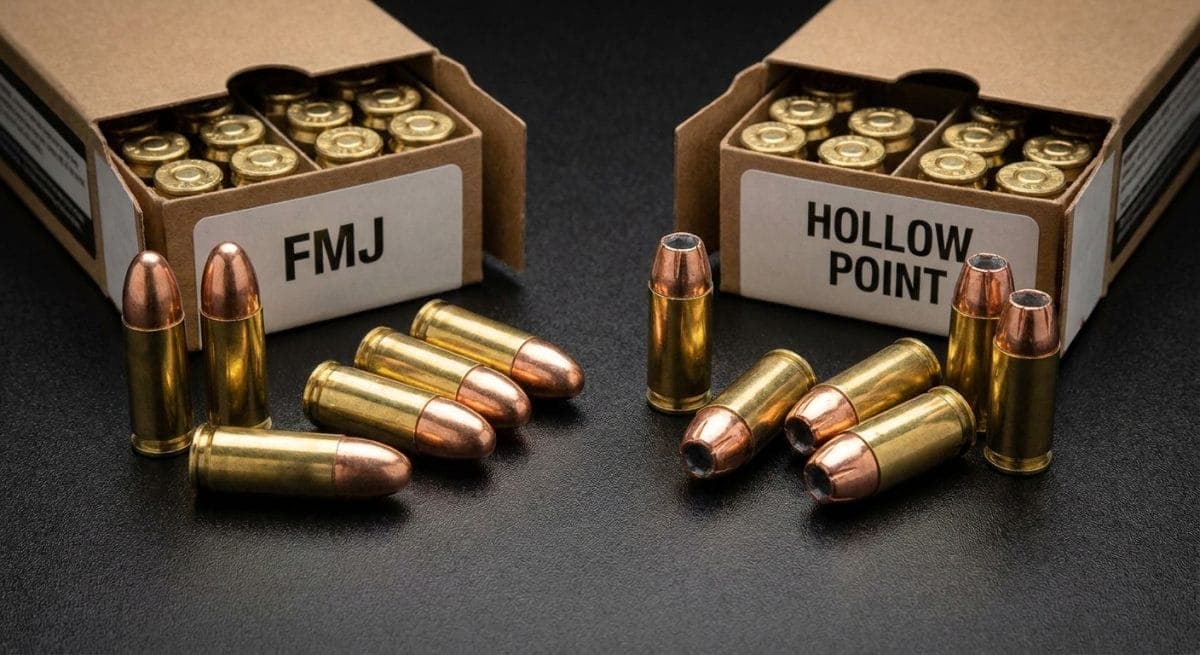
FMJ vs Hollow Point Ammo: Differences, Costs, and When to Use Each
Full metal jacket (FMJ) and jacketed hollow point (JHP) cartridges are the two bullet designs most shooters encounter at the counter. They share brass, primers, and powder charges, but their projectiles behave very differently once they leave the muzzle. This guide breaks down the construction, ballistics, terminal performance, legal considerations, and cost per round so you can match the right load to training, competition, hunting, or self-defense.
Bullet Construction: What You Are Actually Buying
Full Metal Jacket (FMJ)
An FMJ bullet uses a soft lead core surrounded by a harder metal jacket, usually gilding metal (a copper-zinc alloy) or copper-plated steel. The jacket encloses the nose and sides of the bullet while leaving the base exposed. The design dates to the 1880s when smokeless powder velocities melted exposed lead in rifle bores. The jacket keeps the bore clean, supports higher velocities, and produces a profile that feeds reliably in semi-automatic actions.
Because the jacket is closed at the front, FMJ projectiles resist deformation on impact. They tend to punch straight through soft targets, retaining most of their original diameter. That is exactly what you want on a paper target or steel plate, and it is why every military on earth issues FMJ for general combat use under the 1899 Hague Convention.
Jacketed Hollow Point (JHP)
A hollow point carries a cavity machined or formed into the nose of the bullet. On impact with soft tissue, hydraulic pressure forces the cavity open, peeling the jacket and core outward into a mushroom shape. Modern bonded or mechanically locked designs (Federal HST, Speer Gold Dot, Hornady Critical Duty, Winchester Ranger T) are engineered to expand reliably after passing through common barriers like heavy clothing, drywall, or auto glass while still penetrating 12 to 18 inches of ballistic gelatin, the FBI protocol standard.
Ballistics Basics: Velocity, Energy, and Terminal Effect
SAAMI publishes maximum average pressures and velocity reference data for every standardized cartridge. For 9mm Luger, SAAMI lists a maximum average pressure of 35,000 psi and a standard 115-grain FMJ load leaving the muzzle around 1,180 fps, producing roughly 355 ft-lbs of energy. A 124-grain JHP defense load typically runs 1,150 fps for about 364 ft-lbs. The numbers are nearly identical, which is the point: match your carry ammo velocity to what you trained with.
What differs dramatically is terminal performance:
- Expansion: A quality 9mm JHP expands to roughly 0.55 to 0.72 inches from a starting diameter of 0.355 inches. FMJ stays at 0.355 inches.
- Penetration: FMJ in 9mm routinely exceeds 24 inches in bare gelatin. JHP in the same caliber lands inside the FBI 12 to 18 inch window.
- Energy transfer: Expansion increases drag, dumping more energy into the target rather than carrying it downrange.
- Overpenetration risk: FMJ is more likely to exit a target and strike something behind it, a serious concern in a home or public setting.
When to Use FMJ
- Range training and practice: FMJ is cheaper and feeds reliably in almost every semi-auto.
- High-volume drills: Competition, classes, and skill building where you will burn 200 to 1,000 rounds in a session.
- Indoor range compliance: Some ranges ban steel-core or bimetal-jacketed ammo. Check first.
- Break-in and function testing: Run FMJ to confirm a new pistol cycles before testing premium defensive loads.
FMJ is generally a poor choice for hunting anything larger than small varmints because it fails to expand and creates narrow wound channels that may not produce a quick, humane kill. It is also a poor self-defense choice for the same reasons plus the overpenetration issue.
When to Use Hollow Points
- Concealed carry and home defense: Reliable expansion and controlled penetration are what modern JHPs are designed to deliver.
- Duty use: Law enforcement agencies across the US issue bonded JHPs that pass the FBI barrier protocol.
- Handgun hunting: Heavy JHPs in calibers like 10mm Auto, .44 Magnum, and .357 Magnum deliver deeper penetration with controlled expansion.
- Areas with overpenetration concerns: Apartments, homes with family members in adjoining rooms, or urban environments.
Legal Note on Hollow Points
Hollow points are legal for civilian purchase and carry in 49 states. New Jersey restricts hollow point possession primarily to the home and direct transport to a range or hunting area under N.J.S.A. 2C:39-3(f). Always verify local statutes before traveling with defensive ammunition.
Cost Per Round: What You Will Actually Pay
Pricing fluctuates with component costs and demand, but the ratio between FMJ and JHP remains fairly consistent. The numbers below reflect typical online retailer pricing in bulk and box quantities as of recent survey data from SGAmmo, Target Sports USA, Brownells, and Lucky Gunner.
9mm Luger
- Blazer Brass 115gr FMJ, 50 rounds: approximately $14.99, or $0.30/round
- Winchester White Box 115gr FMJ, 100 round value pack: approximately $29.99, or $0.30/round
- Magtech 124gr FMJ, 1,000 round case: approximately $259, or $0.26/round
- Federal HST 124gr JHP, 20 rounds: approximately $23.99, or $1.20/round
- Speer Gold Dot 124gr JHP, 50 rounds: approximately $49.99, or $1.00/round
- Hornady Critical Duty 135gr +P, 25 rounds: approximately $28.99, or $1.16/round
.45 ACP
- Blazer Brass 230gr FMJ, 50 rounds: approximately $27.99, or $0.56/round
- Magtech 230gr FMJ, 1,000 round case: approximately $499, or $0.50/round
- Federal HST 230gr JHP, 20 rounds: approximately $27.99, or $1.40/round
- Hornady Critical Defense 185gr FTX, 20 rounds: approximately $26.99, or $1.35/round
.223 Remington / 5.56 NATO
- PMC Bronze 55gr FMJ, 20 rounds: approximately $8.99, or $0.45/round
- Federal American Eagle 55gr FMJ, 1,000 round case: approximately $439, or $0.44/round
- Hornady Black 62gr FMJ, 20 rounds: approximately $16.99, or $0.85/round
- Federal Fusion 62gr SP, 20 rounds: approximately $24.99, or $1.25/round
The general rule: expect to pay three to four times more per round for premium defensive JHP compared to bulk FMJ. That cost is justified only because you need the JHP to perform flawlessly one time, not thousands.
Recommended Ammunition Strategy
- Buy a case of FMJ for practice. Cost per round drops meaningfully at 500 and 1,000 round quantities.
- Select a premium JHP load from a major manufacturer with an FBI-protocol track record.
- Run at least 100 to 200 rounds of your chosen JHP through your carry gun to confirm function, point of impact, and magazine compatibility.
- Rotate carry ammo annually. Chambered rounds can experience bullet setback from repeated chambering, which raises pressure.
Common Questions
Will FMJ work for self-defense in a pinch?
Yes, it is better than nothing, but it is the least favorable choice because of overpenetration and narrow wound channels. Use JHP whenever possible.
Do hollow points jam more than FMJ?
Two decades ago the concern had some merit. Modern JHPs from Federal, Speer, Hornady, Winchester, and Sig Sauer feature ogive profiles that feed as reliably as FMJ in quality handguns. Still, confirm with your own gun before you bet your life on it.
What about soft point (SP) bullets?
Soft points expose lead at the tip but lack a cavity. They are common in rifle hunting loads. Expansion is moderate and more gradual than a JHP, which is useful for medium and large game where deeper penetration matters.
Can I use hollow points for hunting?
For handgun hunting, yes, choose heavy-for-caliber bonded JHPs. For rifle hunting, use purpose-built hunting bullets like soft points, bonded cores (Federal Fusion, Nosler AccuBond), or controlled expansion designs (Barnes TSX). Target-style hollow point rifle bullets such as match BTHPs are designed for accuracy, not terminal performance, and are not ideal hunting projectiles.
Bottom Line
FMJ is your training currency: cheap, reliable, and easy on the wallet at $0.26 to $0.45 per round in common pistol calibers. Hollow points are your insurance policy: engineered projectiles designed to expand, control penetration depth, and transfer energy into a threat while reducing the risk of hitting someone behind it. The smart shooter stocks both, practices with FMJ, and carries JHP that has been thoroughly tested in their specific firearm.
Published by the Precision Ammo Editorial Team. This article was drafted using AI writing tools and reviewed for accuracy by our editorial team. All data claims have been verified against the sources cited inline.
Building a rifle for this caliber?
Configure a complete AR-15 platform with parts priced by our sister site.
Build a rifle on AR15 Outfitters →